Monostable 555 timer - 8-bit computer clock - part 2
4
Bistable 555 - 8-bit computer clock - part 3
5
Clock logic - 8-bit computer clock - part 4
6
SR latch
7
D latch
8
D flip-flop
9
Bus architecture and how register transfers work - 8 bit register - Part 1
10
Tri-state logic: Connecting multiple outputs together - 8 bit register - Part 2
11
Designing and building a 1-bit register - 8 bit register - Part 3
12
Building an 8-bit register - 8-bit register - Part 4
13
Testing our computer's registers - 8-bit register - Part 5
14
Twos complement: Negative numbers in binary
15
ALU Design
16
Building the ALU
17
Troubleshooting the ALU
18
Testing the computer's ALU
19
8-bit computer RAM intro
20
RAM module build - part 1
21
RAM module build - part 2
22
RAM module build - part 3
23
RAM module testing and troubleshooting
24
JK flip-flop
25
JK flip-flop racing
26
Master-slave JK flip-flop
27
Binary counter
28
Program counter design
29
Program counter build
30
Designing a 7-segment hex decoder
31
Using an EEPROM to replace combinational logic
32
Build an Arduino EEPROM programmer
33
Build an 8-bit decimal display for our 8-bit computer
34
8-bit computer build: Connecting the bus
35
8-bit CPU control signal overview
36
8-bit CPU control logic: Part 1
37
8-bit CPU control logic: Part 2
38
8-bit CPU control logic: Part 3
39
8-bit CPU reset circuit and power supply tips
40
Reprogramming CPU microcode with an Arduino
41
Adding more machine language instructions to the CPU
42
Making a computer Turing complete
43
CPU flags register
44
Conditional jump instructions
Description:
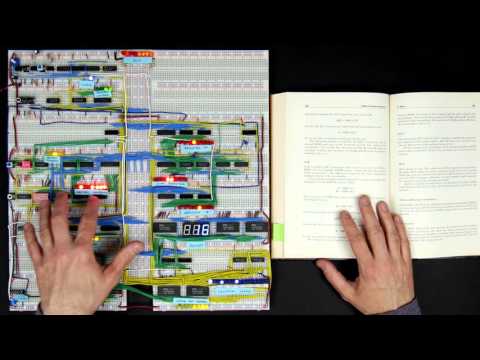
Embark on a comprehensive journey to construct an 8-bit breadboard computer from scratch in this extensive 13-hour video series. Delve into the intricacies of computer architecture, starting with the fundamentals of clock design using 555 timers. Progress through the creation of essential components such as latches, flip-flops, and registers. Explore bus architecture, tri-state logic, and the intricacies of building an Arithmetic Logic Unit (ALU). Gain hands-on experience in designing and implementing RAM modules, program counters, and display systems. Master the art of CPU control logic, microcode programming, and instruction set expansion. Conclude by achieving Turing completeness and implementing advanced features like flags registers and conditional jump instructions, providing a deep understanding of low-level computer operations.