Description:
Explore the third stage of the machine learning process in this 37-minute video focusing on designing an architecture for physics-informed machine learning. Delve into various exciting architectures such as UNets, ResNets, SINDy, PINNs, and Operator networks. Learn how to incorporate physics into the model representation, including known symmetries through custom equivariant layers. Examine case studies, including a pendulum example, to understand the practical applications of physics-informed architectures. Discover the concept of function spaces and their importance in model design. Investigate specialized architectures like Lagrangian Neural Networks, Deep Operator Networks, Fourier Neural Operators, and Graph Neural Networks. Gain insights into the principles of invariance and equivariance in machine learning models for physics applications.
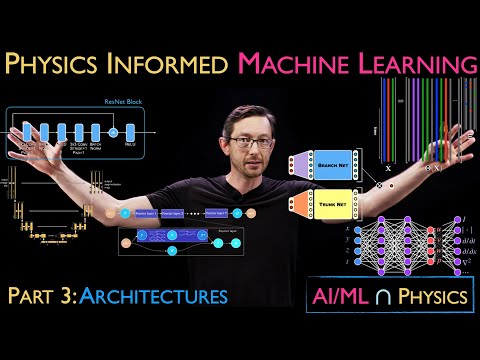
Designing an Architecture for Physics-Informed Machine Learning - Part 3
Add to list
#Computer Science
#Machine Learning
#Science
#Physics
#Artificial Intelligence
#Neural Networks
#Deep Learning
#ResNet
#Physics Informed Machine Learning