Brief Research Talks by Omidyar Postdoctoral Fellows - 2014
Explore cutting-edge research from Omidyar Postdoctoral Fellows at Santa Fe Institute, covering diverse topics in complexity science and interdisciplinary studies.
Breaking the Glass Ceiling: Women in Cancer Research
Explore gender diversity challenges in cancer research, addressing barriers and solutions for promoting equality and inclusivity in scientific careers.
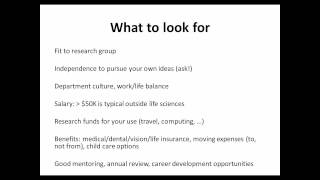
Launching Your Postdoc Position in Physics
Strategies for securing a postdoc in physics: CV preparation, research statements, interviews, and key considerations for success in academia and industry.
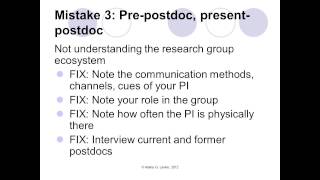
The Biggest Mistakes to Avoid in Postdoc Appointments and How to Recover From Them
Discover common postdoc mistakes and strategies to avoid or overcome them. Learn to take control of your career, create a personalized plan, and leverage your appointment for success in the scientific field.
The Power of a Postdoc - Shaping Your Academic Career
Explore key criteria for choosing postdoc positions, balancing work-life, mitigating career breaks, and navigating career progression in academia.
Primes, Postdocs and Pretentiousness - 2021 CRM-Fields-PIMS Prize Lecture
Explore prime numbers, academic careers, and mathematical concepts in this engaging lecture by renowned mathematician Andrew Granville, offering insights into number theory and research.
Hausdorff School - Introduction by Karl-Theodor Sturm
Innovative postdoctoral program in mathematics offering advanced studies and research opportunities at the Hausdorff Center, presented by coordinator Karl-Theodor Sturm.
Biophysics Postdoc Networking - Bridging Interdisciplinary Boundaries
Explore strategies for navigating the interdisciplinary field of biophysics as a postdoc. Learn from panelists' experiences in collaborative research and career development across diverse scientific disciplines.
Career Pathways in Microbiology 2024 - Non-Academic Postdocs
Explore diverse non-academic career paths for microbiologists with insights from industry experts in cell culture, science policy, and scientific research.
Effective Mentoring Practices - LPI Professional Development Seminar
Explore evidence-based practices for building effective mentoring relationships with experts from Boston University and the Postdoc Academy. Gain valuable resources and insights for professional development.
Navigating the Transition from Graduate Student to Postdoc
Expert panel discusses strategies for finding postdoc positions, approaching mentors, and applying for fellowships, offering valuable insights for grad students considering the next career step.

The Classroom Without Walls: What Learning Really Needs | Akash Tandon | TEDxBVRIT Hyderabad
In this talk, Akash Tandon shares lessons from teaching children in spaces without classrooms, boards, or benches. Through real experiences, he explores what learning truly requires and why emotional safety, dignity, and belief matter more than infrastructure. The talk challenges common assumptions