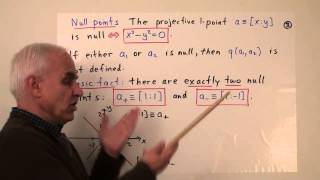
Isometry Groups of the Projective Line III - Rational Geometry Math Foundations
Exploring relativistic geometry in one dimension, extending projective geometry to incorporate Einstein's special theory of relativity and its impact on physics and mathematics.
Existence and Stability of Corotational Wave Maps into Perturbed Spheres
Explore corotational wave maps from Minkowski space to perturbed spheres, examining existence and stability of self-similar solutions in energy-supercritical scenarios.
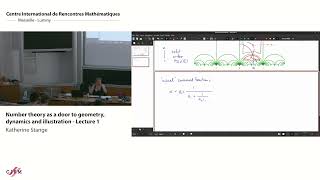
Number Theory Through Geometry, Dynamics and Illustration - Lecture 1
Explore number theory through geometry and dynamics, focusing on continued fractions, Diophantine approximation, and Apollonian circle packings. Emphasizes visual and experimental tools in mathematical research.
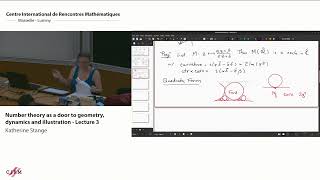
Number Theory Through Geometry, Dynamics and Illustration - Lecture 3
Explore number theory through geometry and dynamics, focusing on continued fractions, Diophantine approximation, and Apollonian circle packings. Emphasizes visual and experimental tools in mathematical research.
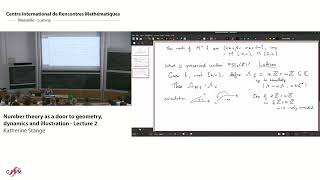
Number Theory Through Geometry, Dynamics and Illustration - Lecture 2
Explore number theory through geometry and dynamics, focusing on continued fractions, Diophantine approximation, and Apollonian circle packings. Emphasizes visual and experimental tools in mathematical research.
Einstein's General Theory of Relativity - Lecture 7
Explore Einstein's General Theory of Relativity, from its historical context to key concepts like the principle of equivalence, gravitational redshift, and field equations. Gain insights into this revolutionary theory of gravity.
ABJM Integrands from Light-Cone Geometries in Minkowski Space
Explore light-cone geometries in Minkowski space and their connection to ABJM integrands in this advanced physics lecture by Jonah Stalknecht.
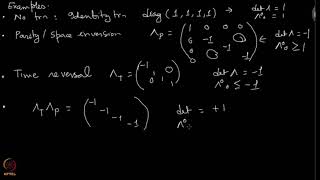
Lorentz Transformations in Quantum Field Theory
Explore Lorentz transformations in quantum field theory, focusing on scalar fields. Gain insights into this fundamental concept from Prof. Anurag Tripathi of IIT Hyderabad.
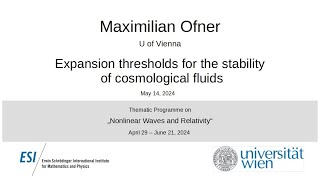
Expansion Thresholds for the Stability of Cosmological Fluids
Explore stability thresholds for cosmological fluids in expanding universes. Examine recent progress on homogeneous fluid states and their dependence on expansion rates.
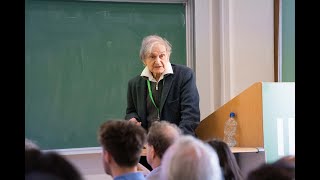
From the Origins of Twistor Theory to Bi-Twistors and Curved Space-Times
Explore the origins and evolution of twistor theory, from its quantum field theory roots to applications in curved space-times, with Professor Roger Penrose.
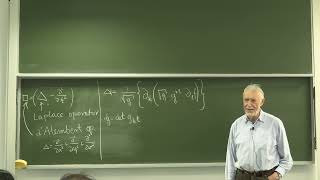
Wave Equation in 4D Spacetime - Introduction to Electrodynamics and Theory of Relativity
Explore wave equations in 4D spacetime, delving into electrodynamics and relativity theory with Professor Jerzy Kijowski's advanced physics lecture.

You Are Traveling at the Speed of Light Right Now - Understanding Special Relativity
Discover how Einstein's relativity reveals we're constantly moving at light speed through spacetime, challenging common misconceptions about motion and the universe's speed limit.