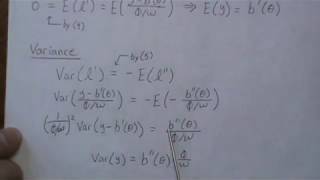
Generalized Linear Models
Comprehensive exploration of Generalized Linear Models, covering various regression techniques including Probit, Logistic, Complementary Log-Log, Poisson, Ordinal Logistic, and Multinomial Logistic.
Instrumental Variable Estimation for Multiple Linear Regression Models - Part IV
Explore IV techniques for MLRM, generalized MLRM, multiple instruments, and endogenous variables in econometric modeling.
Instrumental Variable Estimation - Part III
Explore IV techniques for MLRM, Generalised MLRM, multiple instruments, and endogenous variables in econometric analysis.
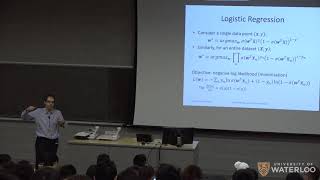
Logistic Regression and Generalized Linear Models
Explore exponential family models, logistic regression, and Newton's method for classification tasks, with applications in app recommendation and sparse data analysis.

Statistical Rethinking 2023 - Modeling Events
Explore statistical modeling for events, covering discrimination, mediation, generative models, and generalized linear models. Learn to analyze and compute interventions, with a bonus on survival analysis.

Statistical Rethinking 2022 - Modeling Events
Explore statistical modeling of events, covering generative models, generalized linear models, logistic regression, and binomial regression. Learn to analyze gender applications and calculate marginal causal effects.
Estimating Separable Matching Models
Explores methods for estimating separable matching models with transferable utility, focusing on minimum distance estimation and reformulation of the Choo and Siow model as a generalized linear model with two-way fixed effects.
Sparsifying Generalized Linear Models
Explores sparsification of sums in generalized linear models, presenting algorithms for efficient computation and applications to optimization problems like regression.

Statistical Rethinking 2023
Comprehensive exploration of advanced statistical concepts, from basic models to complex techniques like Gaussian Processes and Generalized Linear Models, enhancing analytical skills for data interpretation.
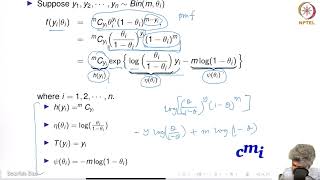
Generalised Linear Models: Introduction to Natural Exponential Family and Binomial Distributions
Explore Generalised Linear Models and Natural Exponential Family, focusing on Binomial Distributions and their applications in statistical modeling.
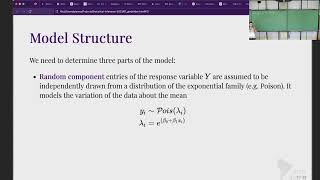
Statistical Models: Linking Data to Theory - Class 9
Explore statistical models linking data to theory, focusing on generalized linear models, binary data, logistic regression, and Poisson distribution in quantitative ecology.

Model Explanation and Prediction Exploration Using Spark ML
Explore techniques for explaining non-linear models, showing feature contributions, and performing what-if analysis using Spark ML. Implement these methods to enhance model interpretability and enable interactive prediction exploration.
Hitting the High-Dimensional Notes - An ODE for SGD Learning Dynamics in High-Dimensions
Explore stochastic optimization algorithms in high dimensions, analyzing dynamics and performance of SGD and momentum methods using a framework inspired by random matrix theory.
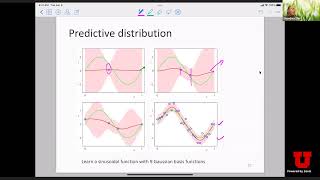
Generalized Linear Models and Linear Regression - Lecture 11
Dive into advanced statistical concepts including generalized linear models, nonlinear basis functions, and regularization techniques for robust data analysis and point estimation.