
Artificial Intelligence
Comprehensive exploration of AI fundamentals, covering search algorithms, logic, planning, reasoning under uncertainty, and machine learning techniques like decision trees and neural networks.
Divide and Conquer - Concept-based Models for Efficient Transfer Learning
Exploring concept-based interpretable AI models for efficient transfer learning in healthcare, focusing on generalizability and minimal data requirements for domain adaptation in medical imaging.
Transformer Expressivity and Formal Logic
Explore the relationship between transformers and formal logic, uncovering their abilities, limitations, and implications for computational models.

Mestrado: Computação, Lógica e Teoria dos Conjuntos - Aula 01
Explore fundamentos de computação, lógica e teoria dos conjuntos em aula de mestrado. Aborde linguagens formais, máquinas de registro, decidibilidade, complexidade algorítmica e lógica de primeira ordem.
Tame Control Theory
Explore tame geometry in control theory, covering basic definitions, motivation, logic, and vector fields. Gain insights into descriptive set theory and generic structures.
Learning Logically Defined Hypotheses - Martin Grohe, RWTH Aachen University
Explore a declarative framework for machine learning using logic-defined hypotheses, discussing learnability results for various logics over strings, trees, and graphs.
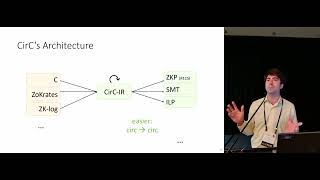
CirC - Compiler Infrastructure for Proof Systems, Software Verification, and More
Explore compiler infrastructure for proof systems and software verification, focusing on CirC's capabilities, multiparty computation, and potential applications in various domains.
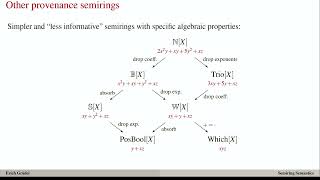
Semiring Semantics
Explore semiring semantics in logic, evaluating statements with values beyond true/false. Learn applications in database queries, provenance analysis, and extensions to various logical systems.

Complete First-Order Reasoning for Properties of Functional Programs - OOPSLA 2023
Explore complete first-order reasoning for functional program properties, uncovering theoretical foundations of verification tools and explaining their efficacy, limitations, and user assistance role.
Finding Infinite Counter-Models in Deductive Verification
Explore innovative techniques for finding infinite counter-models in deductive verification, enhancing automated solvers' capabilities and providing valuable insights for verification failures.
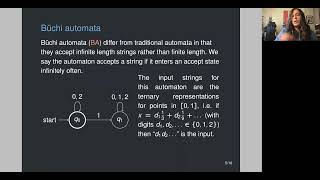
Buchi Automata and Fractals on R
Explore Buchi automata and fractals on R, covering regular languages, model theory, and first-order logic. Gain insights into sparse sets and omega languages in this mathematical journey.
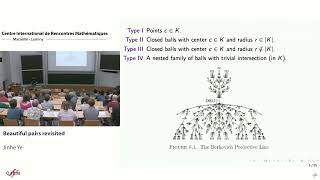
Beautiful Pairs Revisited
Explore the concept of beautiful pairs in model theory, revisiting key ideas and applications in valued fields.
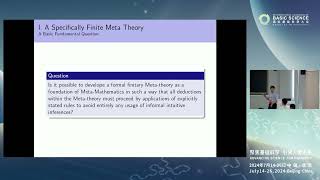
On A Finitary Formal Meta-theory of Meta-mathematics - ICBS 2024
Explore a finitary formal meta-theory of meta-mathematics, merging Cantor, Frege, and Zermelo's ideas. Examine formal deductions, predicative definitions, and finitary methods in set theory and logic.
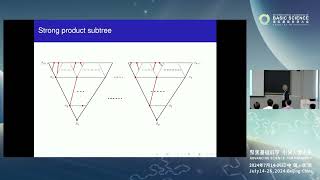
Infinitary Combinatorics and Finitary Arithmetic
Explore recent developments in characterizing Ramsey-type combinatorial principles within reverse mathematics, focusing on proof-theoretic strength analysis.
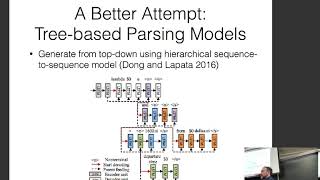
Neural Nets for NLP 2018 - Neural Semantic Parsing
Explore neural semantic parsing techniques, including tree-based models, code generation, weakly supervised learning, and various meaning representations. Learn about graph structures and neural approaches to semantic role labeling.
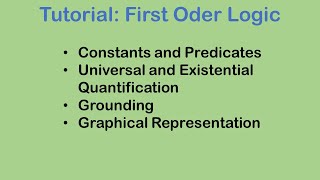
First Order Logic (FOL) Tutorial - Predicate Calculus and Knowledge Reasoning
Explore first-order logic fundamentals: predicates, constants, variables, quantification, and graphical representations. Essential for knowledge reasoning and logic programming.
Pseudofinite Omega-Categorical Groups
Delve into advanced mathematical concepts exploring pseudofinite omega-categorical groups, featuring insights on model theory and its applications to group theory and combinatorics.
Ramsey Quantifiers in First-Order Logic - Complexity and Applications to Verification
Exploring Ramsey quantifiers in first-order logic, their complexity, and applications to verification, with focus on liveness and termination in infinite-state systems.
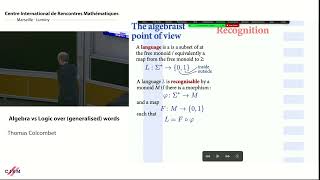
Algebra vs Logic over Generalized Words
Explore algebraic and logical perspectives on generalized words, comparing approaches and examining key concepts in discrete mathematics and theoretical computer science.