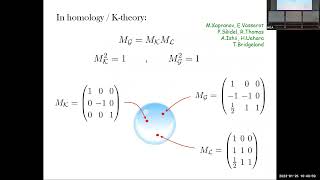
Homological Mirror Symmetry - Coulomb Branches & Rozansky-Witten Theory Pt. II
Explore Rozansky-Witten theory and its connection to homological mirror symmetry, from basics to modern developments involving non-compact and infinite-dimensional target spaces.
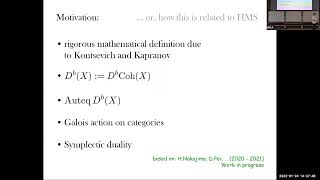
Homological Mirror Symmetry - Coulomb Branches and Rozansky-Witten Theory
Explore Rozansky-Witten theory and its connection to homological mirror symmetry, from basics to modern developments involving non-compact spaces and ongoing research.
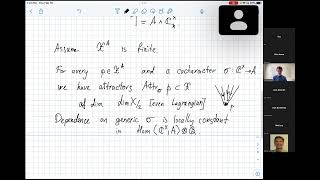
Stable Envelopes from 2D Mirror Symmetry
Explore stable envelopes through 2D mirror symmetry, connecting equivariant K-theory and Fukaya categories in Coulomb branches. Gain insights into homological mirror symmetry predictions.

Embeddings of Kac-Moody Affine Grassmannian Slices
Explorez les développements récents dans la théorie des représentations géométriques, en se concentrant sur les tranches de Grassmanniennes affines de type Kac-Moody et leur construction via les branches de Coulomb.

Special Holonomy and Geometric Structures on Complex Manifolds
Explore advanced topics in differential geometry, including special holonomy, complex manifolds, and their connections to various mathematical fields and theoretical physics.

Branes and Quivers in String Theory - Lecture 1
Explore connections between string theory, branes, and quivers. Learn about spatial dimensions, brain setups, Coulomb branches, and moduli spaces in this advanced theoretical physics lecture.

The Curved Cartan Complex Revisited
Explore the Curved Cartan Complex's role in computing gauged algebras and categories, its connection to the Toda system, and applications in 2D mirror symmetry.

Coulomb Branches of 3d N=4 Gauge Theories 2
Explore advanced concepts in gauge theories, focusing on Coulomb branches in 3d N=4 systems. Delve into mathematical physics with expert insights from Hiraku Nakajima.
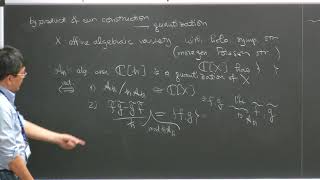
Coulomb Branches of 3D N=4 Gauge Theories
Explore Coulomb branches in 3d N=4 gauge theories, delving into advanced concepts of quantum field theory and supersymmetry with expert insights from Hiraku Nakajima.
Coulomb Branches of 3d N=4 SUSY Gauge Theories and Bow Varieties - Part 2
Explore advanced concepts in supersymmetric gauge theories, focusing on Coulomb branches and bow varieties in 3-dimensional N=4 models with Hiraku Nakajima.
Coulomb Branches of Orthosymplectic Quiver Gauge Theories
Explore orthosymplectic quiver gauge theories, focusing on Coulomb branches, Higgs branches, and integrable systems with expert Hiraku Nakajima.
Coulomb Branches of 3D N=4 SUSY Gauge Theories and Bow Varieties - Part 1
Explore Coulomb branches in 3d N=4 supersymmetric gauge theories and their connection to bow varieties, covering key concepts, technical points, and applications in integrable systems.